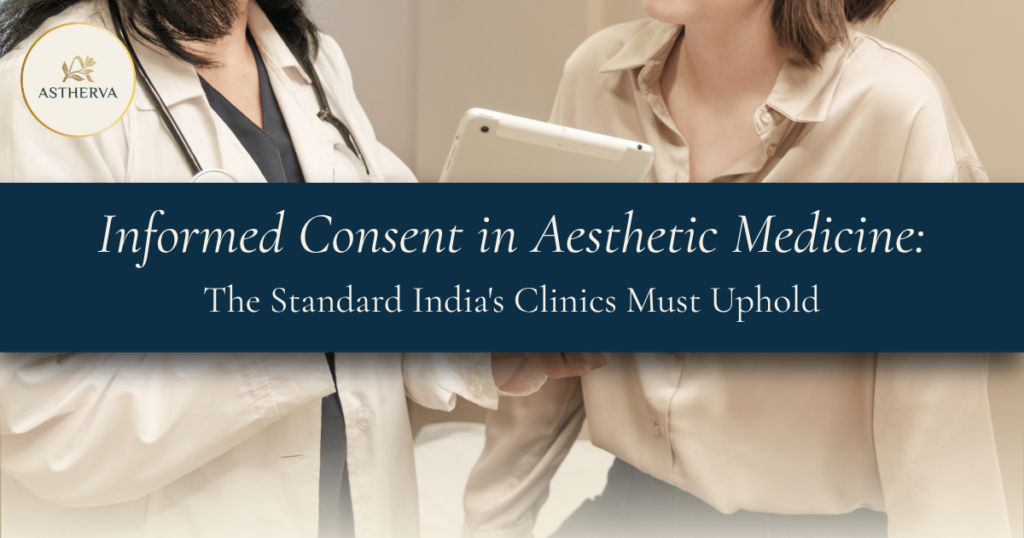
When a Signature Is Not Enough: Rethinking Consent in Aesthetic Medicine in India
There is a version of informed consent in aesthetic medicine that exists on paper and a version that exists in the room. In aesthetic medicine, the distance between the two is often where patients get lost.
Most clinics performing cosmetic procedures in India meet the formal requirements. A document is presented. Risks are listed. A signature is obtained. From an administrative standpoint, the process is complete. From a clinical and ethical standpoint, it has frequently not begun.
This gap — between procedural compliance and meaningful consent — is one of the least discussed quality failures in Indian aesthetic medicine. It does not produce the kind of harm that generates headlines. It produces something quieter and more cumulative: patients who feel that something was done to them rather than chosen by them, dissatisfaction that cannot be precisely articulated, and an erosion of trust in practitioners and in the field itself that builds slowly and is difficult to recover.
Informed consent in aesthetic medicine, practised properly, is a clinical act, not a risk-mitigation exercise. And in a field as psychologically complex as aesthetic medicine, it may be the most consequential one a practitioner performs.
The Regulatory Floor Is Not the Clinical Ceiling
India’s regulatory framework for aesthetic medicine is governed primarily by the Drugs and Cosmetics Act, 1940 and its subsequent amendments, which provide oversight for injectable products and certain medical devices used in cosmetic procedures in India. The Medical Council of India, now succeeded by the National Medical Commission, sets broader professional conduct standards, including the expectation that practitioners obtain informed consent before any procedure.
These frameworks establish a floor. They specify that consent must be obtained. They do not, in meaningful operational detail, define what consent must contain, how much time it requires, or how a practitioner should navigate the significant psychological complexity that often accompanies an aesthetic consultation.
Internationally, the standard is more explicitly defined. The World Medical Association’s Declaration of Helsinki, the foundational document governing ethical conduct in medicine globally, frames consent not as a moment but as a process. The General Medical Council in the United Kingdom, whose guidance is referenced widely in postgraduate medical education in India, is unambiguous: patients must be given sufficient time and relevant information to make voluntary, considered decisions. The landmark Montgomery v Lanarkshire judgment, while a UK legal precedent, has influenced ethical thinking globally — shifting the standard from what a reasonable doctor considers necessary to disclose, to what a reasonable patient would want to know.
In aesthetic medicine, that distinction is particularly significant. Patients are not presenting with a pathology that requires treatment. They are presenting with a perception, an aspiration, or a concern — all of which are shaped by personal, cultural, and psychological factors that a clinical encounter must account for, not bypass.
Why Aesthetic Medicine Requires a Different Consent Standard
Aesthetic procedures occupy a unique position in medicine. They are elective. They are identity-adjacent. And they are carried out on patients who are, by definition, not unwell, which means the risk-benefit calculus (the weighing of potential dangers (risks) against positive outcomes (benefits)) is evaluated against a baseline of normal function, not illness.
This has specific implications for how consent in aesthetic medicine must be structured.
Research published in the Aesthetic Surgery Journal has consistently identified consultation quality as a primary determinant of patient satisfaction: not outcome quality alone, but whether the patient felt heard, informed, and genuinely involved in the decision-making process. A technically precise outcome delivered through a consultation in which the patient felt rushed, unclear, or subtly pressured toward a decision produces lower satisfaction scores than a more modest outcome delivered through a process the patient experienced as respectful and thorough.
This finding reflects something clinically important. In aesthetic medicine, the patient’s relationship with the outcome is mediated by their relationship with the process. Consent is not separable from care. It is part of it.
The International Society of Aesthetic Plastic Surgery has been explicit on this point in its clinical guidance: informed consent in aesthetic practice must extend beyond disclosure of risks to include a discussion of alternatives, realistic expectations of outcomes, the limitations of what intervention can achieve, and, critically, the option of no treatment at all. That final point is not a formality. It is a clinical and ethical obligation that reshapes the entire consultation dynamic.
When a patient understands that declining or deferring is a legitimate outcome of the consultation, the conversation changes. They are no longer a consumer selecting from a menu. They are a participant in a clinical assessment. That shift (subtle in language, significant in effect) is what separates a consent process that is meaningful from one that is merely documented.
What Consent Failures Actually Look Like
Consent failures in aesthetic medicine rarely involve outright misrepresentation. They are more typically failures of omission, pacing, and power dynamics.
A consultation that moves quickly toward treatment recommendation without adequate exploration of what the patient actually wants — and why — limits the patient’s ability to make a fully informed decision. A practitioner who presents one option with confidence, without discussing alternatives or the merits of restraint, shapes the patient’s choice before it is made. A consultation room designed to feel like a luxury retail environment rather than a clinical space carries its own implicit pressure.
None of these constitutes misconduct in any formal sense. All of them carry the risk of compromising the integrity of consent.
The psychological literature on aesthetic medicine patients identifies body dysmorphic disorder, attachment to idealised outcomes, and vulnerability to social comparison as factors that can significantly distort decision-making in a consultation context. Screening for these, with genuine attentiveness and not clinical detachment, is part of what a responsible aesthetic practitioner does before any discussion of treatment begins.
In practical terms, this means building consultations that allow more questions than answers in the early stages. It means creating space for the patient to express hesitation without feeling that hesitation will be overridden. It means, on occasion, recommending that a patient return at a later point before any decision is made, or that they do not proceed at all.
These may not be commercially comfortable outcomes. However, they are clinically correct ones.
Applied Consent in Aesthetic Medicine: What It Looks Like in Practice
Genuine informed consent in an aesthetic consultation has a recognisable shape. It is slower than the industry norm. It begins with understanding rather than assessment. It distinguishes between what a patient is asking for and what they are actually seeking. These are frequently not identical, and the clinical skill lies in identifying the difference.
At Astherva, the consultation is structured around this principle. Before any treatment is discussed, the objective is clarity — about the patient’s concern, about what is anatomically and realistically achievable, and about whether intervention is appropriate at this point, at a later point, or at all. The most responsible outcome of a consultation is sometimes a conservative one. Occasionally, it is ‘no treatment’.
This is not a reluctance to practise. It is a commitment to practise well. And when it comes to cosmetic procedures in India, where the pressure to convert consultations into procedures is real and commercially significant, maintaining that commitment requires deliberate structural choices — not just good intentions.
For patients navigating a landscape in which quality is difficult to evaluate from the outside, the consultation itself is the clearest signal of clinical standards. A practitioner who takes consent seriously takes everything else seriously, too. That correlation is not incidental.
The Standard the Field Needs
India’s aesthetic medicine sector is at an inflexion point. Demand is expanding. Access is broadening. The practitioners entering the field are doing so in a market that is growing faster than its professional norms are being established.
Informed consent is not a bureaucratic requirement within that landscape. It is the ethical architecture on which everything else rests. It cannot remain a formality administered at the end of a consultation that has already, implicitly, reached its conclusion.
The clinicians who understand this and build their practice around it will define what quality aesthetic medicine looks like in India for the next decade. That is worth getting right from the beginning.
Dr Vikrant Ranjan is a double board-certified plastic surgeon and the founder of Astherva, a plastic surgeon-led aesthetic medicine practice based in Ranchi. His clinical focus is on evidence-based, anatomically considered aesthetic care delivered to the standard that patients deserve.
References
- World Medical Association. Declaration of Helsinki: Ethical Principles for Medical Research Involving Human Subjects. Revised 2013.
- General Medical Council (UK). Consent: Patients and Doctors Making Decisions Together. GMC, 2008.
- Montgomery v Lanarkshire Health Board [2015] UKSC 11. Supreme Court of the United Kingdom.
- International Society of Aesthetic Plastic Surgery (ISAPS). Guidelines on Informed Consent in Aesthetic Practice. ISAPS, 2022.
- Aesthetic Surgery Journal. Patient satisfaction and consultation quality in aesthetic medicine: a systematic review. Aesthetic Surgery Journal, 2019;39(4):389–401.